
The first time I tried a no-buy month, I lasted eleven days.
I don't say this as a confession requiring absolution. I say it because I think the way most no-buy content is framed sets people up to experience normal human behavior as failure, and I'd like to offer a different framing before we get into the practical stuff.
I lasted eleven days, then bought a secondhand jacket I'd been watching on eBay for three weeks, felt vaguely guilty about it, and quietly stopped tracking. The rules I'd set were fuzzy. My reasons for doing it were fuzzy. I hadn't thought through what I'd actually do when the urge to buy something hit — which, when you've spent years in a shopping habit, hits more often than you'd expect in the first couple of weeks.
The second time I tried it, six months later, I made it the full month and actually found the experience interesting rather than grueling. The difference wasn't willpower. It was structure and honesty about what the challenge was actually for.
Here's what I'd tell myself before starting.
Get Specific About Your Rules Before Day One
"No buying clothes" sounds like a complete rule. It isn't. The moment you're standing in front of a secondhand rack or looking at a sale email, you will find yourself negotiating with the edges of it in ways you didn't anticipate.
The questions worth answering before you start:
Does secondhand count? For some people, the goal is specifically to stop spending money, in which case secondhand counts. For others, the goal is to stop acquiring new items regardless of price or source, in which case secondhand also counts. For others still, the goal is to break the habit of buying new and fast fashion specifically, in which case thoughtful secondhand might be fine. None of these is the correct answer — but you need to have picked one before you start, not on day six when you're looking at a ThredUp listing.
What about replacing broken or worn-out basics? If your only pair of black trousers develops a hole in week two, is replacing them a violation? Most people would reasonably say no. But "reasonable exceptions" can expand quickly if you don't define them in advance. I'd suggest a simple test: if the item in question is genuinely no longer functional and you have nothing that serves the same purpose, replacement is fine. If it's functional but imperfect and you've been vaguely wanting to upgrade it, that's not a replacement, that's shopping.
What counts as "clothes"? Does jewelry count? Shoes? A belt? Draw your own line, but draw it explicitly before day one.
My second-attempt rules, which worked for me, were simple: no new clothing purchases of any kind — secondhand, new, gifted with purchase intent — for 31 days. Replacing items that were genuinely unwearable was allowed with a 48-hour waiting period. Everything else was a no.
What to Do When the Urge Hits (Because It Will)
The urge to shop isn't really about the item. Most of the time, it's about something else — boredom, stress, the low-grade restlessness that comes from sitting at a computer too long, or the specific itch triggered by opening Instagram and seeing something that looks good on someone else.
None of this is shameful or unusual. It's just what a well-worn habit feels like when you try to interrupt it. The useful question is: what do you do instead?
A few things that actually worked for me during the second attempt:
Unsubscribe from retail emails for the month. This sounds small and is genuinely significant. A sale email is specifically engineered to create urgency around something you weren't thinking about sixty seconds ago. Removing it from your inbox isn't willpower — it's just reducing the number of times you have to make the decision.
Do a wardrobe inventory instead. When the shopping itch hit, I started using it as a signal to open my closet instead of a browser. Not to do a dramatic reorganization — just to look at what was actually there. I found things I'd forgotten about, combinations I hadn't tried, pieces I'd been avoiding because they needed a small repair I kept putting off. This didn't always fully satisfy the itch, but it redirected it somewhere useful.
Keep a running "want list" instead of a "do not buy" list. Write down the things you want to buy but aren't buying. Don't frame it as denial — frame it as a waiting list. At the end of the month, look at the list. Some items will still seem worth buying. A surprising number will have dropped off entirely. The ones that remain are better candidates for intentional purchasing than anything you'd have impulse-bought during the month.
Give yourself something to notice. A no-buy month is more interesting if you treat it as an experiment rather than a punishment. I kept loose notes on what I wanted to buy and why, what I wore instead, and whether I actually missed the things I didn't buy. By the end of the month I had a clearer picture of my actual shopping patterns than I'd had in years — which items I kept mentally reaching for suggested my wardrobe had real gaps; which ones I forgot about within a week suggested they were impulse-driven.

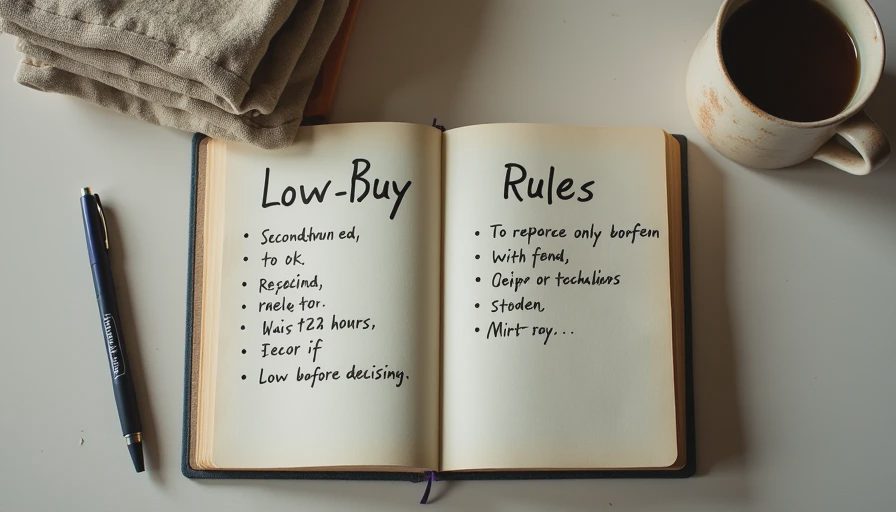
Low-Buy vs. No-Buy: Picking the Version That Fits Your Life
A full no-buy month isn't the only option, and for some people it's not the right starting point. A low-buy version — where you set a specific spending limit rather than a complete ban — can be more realistic and still produces most of the same insight.
The format I've seen work well for people who are newer to this:
Rule Type | Works Well For |
|---|---|
Full no-buy | People who want a clean break from a strong shopping habit, or who want maximum clarity on what they actually need |
Low-buy with a budget cap | People with more moderate habits who want to be more intentional without going cold turkey |
Category-specific ban | People who have one particular problem area (sale shopping, fast fashion, impulse accessories) they want to address specifically |
Secondhand-only | People whose goal is specifically to stop buying new rather than to stop acquiring |
The version that's slightly too easy won't teach you much. The version that feels slightly uncomfortable but achievable is usually the right calibration.
What You're Actually Trying to Find Out
The most useful thing a no-buy or low-buy month does isn't save you money, though it usually does that too. It shows you what your actual shopping patterns are, as distinct from what you think they are.
Most people who try this are surprised by at least one of the following: how often the urge to shop hits (more frequently than expected), how many of the urges pass within an hour without being acted on (more than expected), how much of their shopping is triggered by external cues like emails and social media rather than genuine need (more than expected), and how adequately their existing wardrobe covers their actual daily life (better than expected).
That last one is the one that tends to stick. Most people who complete a no-buy month don't emerge thinking "I need to go shopping immediately." They emerge with a more calibrated sense of what they actually need versus what the habit of shopping had been suggesting they needed.
That recalibration is the point. The month is just how you create the conditions for it.


Travellers Write
No letters yet — be the first traveller to write.