
At some point over the last few years, sustainable fashion developed a dominant aesthetic. You probably recognize it: cream linen, camel wool, natural undyed cotton, structured coats in biscuit and oatmeal tones, expensive leather footwear in cognac or tan. Pieces that photograph beautifully on light-colored walls. Brands that use the word "timeless" a lot and whose lookbooks are shot in Provence or on Scandinavian coastlines.
This aesthetic is genuinely beautiful. A lot of the brands producing it are also genuinely doing more thoughtful work than fast fashion alternatives. I own pieces that fit this aesthetic — the oatmeal cashmere crewneck, the linen shirt, the cognac loafers. None of that is a problem.
The problem is when this aesthetic gets conflated with sustainability itself — when "sustainable dressing" starts to implicitly mean "dressing in this particular way," and when other approaches to sustainable dressing get treated as less serious or less valid.
I want to push back on that conflation, because I think it does a few things worth examining.
What the Quiet Luxury Aesthetic Actually Selects For
Let's be specific about what the dominant sustainable aesthetic requires.
It requires a significant budget, even secondhand. The quiet luxury version of sustainable dressing — quality cashmere, vegetable-tanned leather, structured wool coats from transparent brands — is not cheap. Even sourced secondhand, a wardrobe built primarily on these pieces requires meaningful disposable income. A $22 cashmere sweater on ThredUp is a real find, but building an entire wardrobe of equivalents takes time, money, and considerable secondhand shopping skill. The aspirational version shown in most sustainable fashion content — new pieces from certified sustainable brands, organized in a beautiful minimal closet — costs several thousand dollars at minimum.
This doesn't make the aesthetic wrong. But it's worth naming: the "sustainable wardrobe" most prominently represented in the media is a luxury product, and framing it as the standard implicitly suggests that people without access to that budget aren't dressing sustainably. That's not accurate and it's not a useful framing.
It works best on a specific range of skin tones. Cream, oatmeal, camel, biscuit — these are colors that photograph particularly well and tend to be flattering against lighter skin tones. They are substantially less straightforward against darker skin tones, where the contrast doesn't read the same way. The quiet luxury aesthetic was developed largely within a white-dominated media context, and the color palette reflects that context more than it reflects a universal ideal of what sustainable dressing looks like.
Again, this isn't an argument that no one should wear neutral tones. It's an argument that a color palette that works for some people should not be elevated to a universal standard of aesthetic virtue, especially when that elevation happens largely within a space that wasn't particularly diverse to begin with.
It requires a specific lifestyle legibility. The quiet luxury sustainable look reads a certain way socially — it signals a particular cultural context, income bracket, and set of priorities. That legibility is part of its appeal in the communities where it originated, and part of what makes it feel aspirational.
It's also not the only legibility that's available. A person who dresses sustainably in vintage workwear, or in secondhand statement pieces, or in natural-fiber clothes that happen to have color and pattern, is making equally valid choices and often doing so with more creative constraint — finding genuinely sustainable pieces that don't fit the beige-linen template requires more wardrobe skill, not less.
What Sustainable Dressing Actually Looks Like in a Wider Frame
The actual principles of sustainable dressing are material and behavioral, not aesthetic.
Buying secondhand or from brands with meaningful transparency. Choosing natural fibers over synthetics where possible. Caring for what you own. Repairing rather than replacing. Wearing things enough times to justify acquiring them. Buying slowly and intentionally.
None of those principles specify a color palette. None of them require linen specifically. None of them favor cream over rust or camel over indigo. The behavioral commitments that make dressing sustainable are available to anyone with any aesthetic, at any budget above subsistence, in any climate.
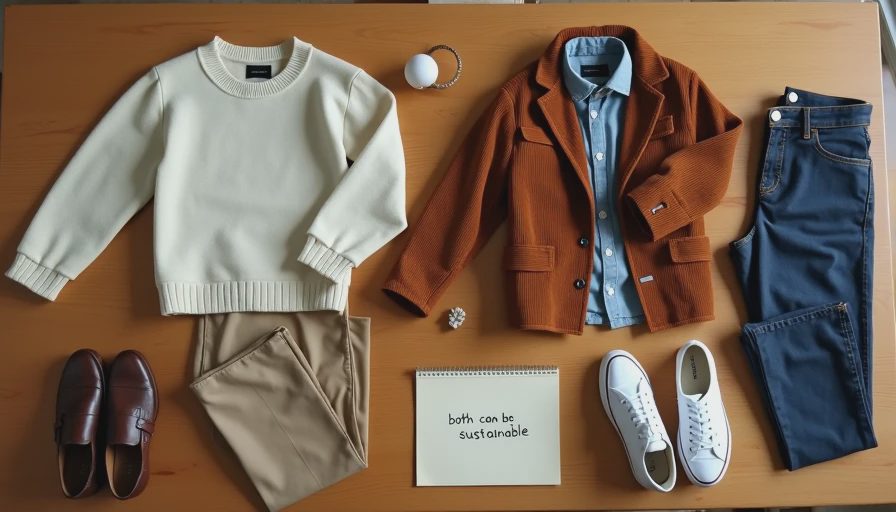
My own wardrobe is mostly neutrals, because neutrals are genuinely what I reach for and what works for my life. But I have a rust corduroy jacket that was $8 at a thrift store in Northeast Portland, made in the 1990s from actual quality corduroy, that I've worn probably forty times in the past year. It is a better sustainable fashion choice than a $180 cream linen shirt from a certified-sustainable brand that I'd wear twelve times a year, by any meaningful metric.
The corduroy jacket doesn't fit the quiet luxury aesthetic. It has color and texture and a specificity that the beige template doesn't accommodate. It also cost $8, was made well, has lasted thirty years, and will probably last thirty more.
That's sustainability. The fact that it doesn't photograph well on a white wall is irrelevant.

Making Space for Other Aesthetics
What I'd actually like to see more of in sustainable fashion content — including on this blog — is the full range of what sustainable dressing looks like across different aesthetics, budgets, skin tones, climates, and lifestyles.
The person who thrifts workwear and wears it until it falls apart. The person who buys secondhand statement pieces and constructs a wardrobe with genuine visual personality. The person in a non-temperate climate who dresses sustainably in ways that don't resemble Pacific Northwest slow-living content at all. The person with a limited budget who applies sustainable principles within real financial constraints and ends up with something that looks nothing like a curated capsule wardrobe.
These are all valid. They're all, by meaningful measures, more sustainable than a lot of what gets labeled sustainable fashion by mainstream media.
I write from my own experience, which is white, Pacific Northwest, moderately resourced, and inclined toward neutrals. That's an honest position, and I'll keep writing from it because it's the experience I actually have. But I want to be clear that what I do is a version of sustainable dressing, not the version — and that the beige-and-linen aesthetic that currently dominates the space is a choice, not a requirement.
The principles are the constant. The aesthetic is a variable. If your version of sustainable dressing looks different from mine, you're probably doing it right.



Travellers Write
No letters yet — be the first traveller to write.