
I want to start by saying that I am not naturally a minimalist dresser.
I find clothes interesting in the way that some people find furniture or ceramics or typography interesting — there's a genuine aesthetic pleasure in a well-proportioned outfit, in the way a particular fabric drapes, in unexpected combinations that somehow work. That interest doesn't disappear just because I've decided to buy less. It goes somewhere, and if I don't find a productive channel for it, it turns into restlessness that starts to look a lot like a shopping itch.
This is why most minimalist wardrobe content doesn't fully resonate with me. A lot of it treats "not getting bored" as a character defect to overcome — as though the goal is to care so little about how you dress that any selection of clean, functional clothing satisfies you. Some people are genuinely like that. I'm not. And I suspect a lot of people who try and fail at outfit repeating or capsule wardrobes aren't either.
The version of this that works for me isn't about caring less about clothes. It's about finding enough variation and interest within a small wardrobe that the itch to buy something new gets answered by what I already own.
Here's how I've built that.
Finding the Variables Within What You Already Have
The premise of outfit repeating is that you're wearing the same pieces. The practice of outfit repeating, for people who get bored, is about identifying all the ways you can legitimately vary those pieces without buying anything.
There are more variables than most people use.
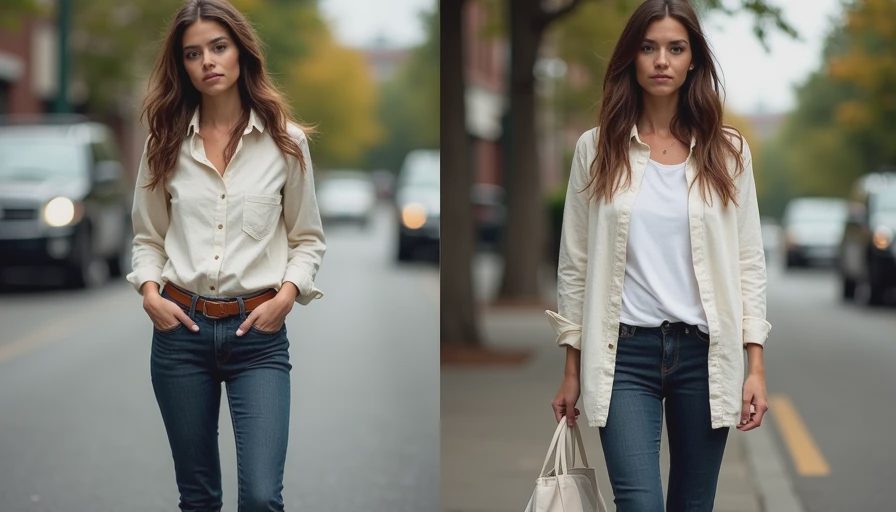
Proportional shifts. The same shirt can read completely differently depending on how it's worn. Tucked fully into high-waisted trousers with a belt is a different silhouette from the same shirt half-tucked into mid-rise jeans. Layered open over a tee is a third silhouette. Worn alone, buttoned to the collar, is a fourth. None of these require different pieces. They require different choices about how you're wearing the pieces you have.
Proportional shifts are probably the highest-leverage variable in outfit repeating, and they're the one most people use least consistently. Most people have one default way of wearing each piece and rarely depart from it. The habit of consciously asking "how else could this be worn" turns a wardrobe of 25 pieces into something that functions like a wardrobe of 60.
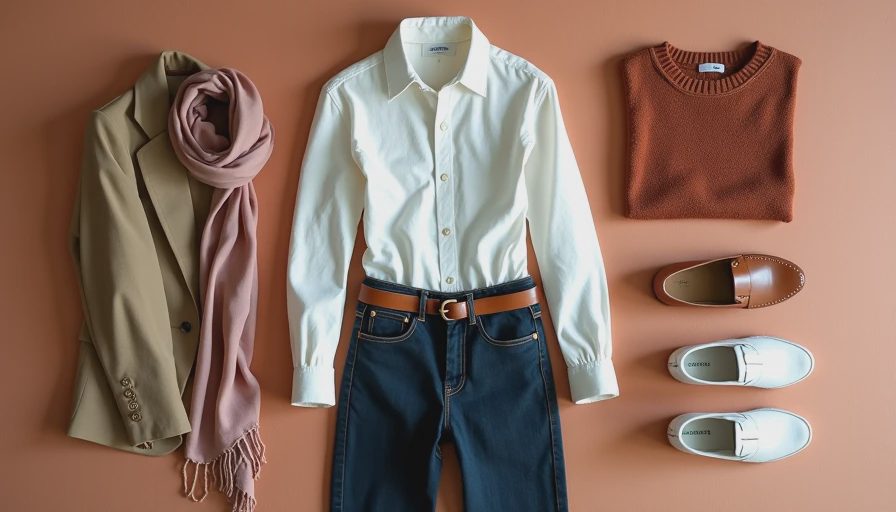
Register shifts. Register is the word I use for where an outfit sits on the casual-to-formal spectrum. The same pair of trousers worn with a structured blazer and loafers sits at a different register than the same trousers worn with a knit and white sneakers. Neither combination requires new pieces — just awareness of how different shoes and layering pieces shift where an outfit reads.
Understanding register gives you a practical reason to vary combinations, because your actual life has different register requirements on different days. The same core pieces can be dressed up or dressed down, but you have to actually use that range rather than defaulting to one register out of habit.
Layering logic. Most wardrobe advice talks about layering as a winter-warmth strategy. It's also a visual interest strategy. A cream shirt under an open linen overshirt is visually different from the same cream shirt worn alone, even in identical weather. A simple knit as a mid-layer under a blazer reads differently from the blazer worn directly over a tee. Playing with layering order and combinations is a source of outfit variation that costs nothing.
Accessories as the variable. I keep accessories minimal — a thin belt, a simple gold chain, occasionally a scarf — but using them intentionally creates meaningful variation. A belt changes proportion. A scarf adds texture and color. A chain necklace shifts an outfit slightly up the register register without changing any of the core pieces. These small changes are disproportionately effective at making the same outfit feel different.
Color and texture contrast within a neutral palette. Working within neutral colors doesn't mean every outfit looks the same. Cream next to camel is different from cream next to navy. A rough linen layered with smooth cashmere has a texture contrast that makes an outfit more visually interesting than either piece alone. Learning to think about contrast within a limited palette is a skill that makes outfit repeating feel like dressing rather than just getting dressed.
Staying Interested Without Buying
The other part of this, and the part that's more psychological than practical, is finding ways to stay engaged with your wardrobe without shopping as the mechanism.
A few things that actually work for me:
Periodic wardrobe reorganization. Not as a declutter exercise — just as a way of seeing what I have with fresh eyes. About once a month, I pull things out, refold them differently, rearrange the hanging pieces. Things I'd been sliding past show up again. Combinations I'd forgotten about become visible. This is a low-effort, zero-cost way of refreshing the relationship with a fixed set of pieces.
Outfit photography, privately. I know outfit content is a whole genre of social media and I'm not suggesting you become an outfit blogger. But taking photos of outfits I like — for myself, in my camera roll — has been genuinely useful for two reasons. First, it slows down the getting-dressed moment and turns it into something more deliberate and enjoyable. Second, it creates a record of what I've worn and what worked, which I can look back at when I feel like I have nothing to wear. I'll scroll through six months of outfit photos and realize I have more combinations I like than I remembered.
Resting pieces and returning to them. Not every piece in my wardrobe is in active rotation at all times. Some things I'll wear heavily for a month and then not reach for. Rather than reading that as the piece failing, I've started to think of it as a natural rhythm. A piece that felt stale in March sometimes feels fresh in September, because my eye has moved on and come back around. Deliberately resting pieces rather than replacing them is a way of keeping the wardrobe feeling larger than it is.
Treating combinations as a creative problem. This is the mindset shift that helped most. The question "I have nothing to wear" is usually really the question "I haven't thought carefully about this yet." Giving myself five minutes to genuinely play with what I have — pulling out things I haven't tried together, thinking about proportion and layering and register — nearly always produces something. The few minutes of creative engagement satisfies the same itch that shopping used to scratch.
The honest version of outfit repeating for people who find clothes interesting is this: it's not about caring less. It's about redirecting the energy from acquiring toward wearing. Those are different activities, but they're drawing on the same underlying pleasure. Once you find the channel, the shopping itch quiets down — not because you've suppressed it, but because it's being answered somewhere else.



Travellers Write
No letters yet — be the first traveller to write.